USCIS 001Give one
What is the form of government of the United States?
- Republic
- Constitution-based federal republic
- Representative democracy
A republic is governed through representatives rather than a hereditary monarch. “Representative democracy” describes how people exercise power through elected officials; the official list accepts both descriptions.
The words describe two features of the same system: public authority is exercised through representatives, and the Constitution sets the rules they must follow. A republic can also be a representative democracy; those labels are not opposites.
USCIS 00265/20 · Give one
What is the supreme law of the land?
The Constitution establishes the framework for the federal government and is the supreme law of the land. Ordinary federal and state laws must fit within that constitutional framework.
The Constitution stands above ordinary legislation. A bill passing Congress does not by itself settle whether that law is constitutional; constitutional limits still apply.
USCIS 003Give one
Name one thing the U.S. Constitution does.
- Forms the government
- Defines powers of government
- Defines the parts of government
- Protects the rights of the people
The Constitution creates the federal government, assigns powers, and protects rights. A single document can establish institutions while limiting what those institutions may do.
A constitution is both a plan and a restraint. It creates offices and assigns responsibilities, while protecting people against the misuse of those powers.
USCIS 004Give one
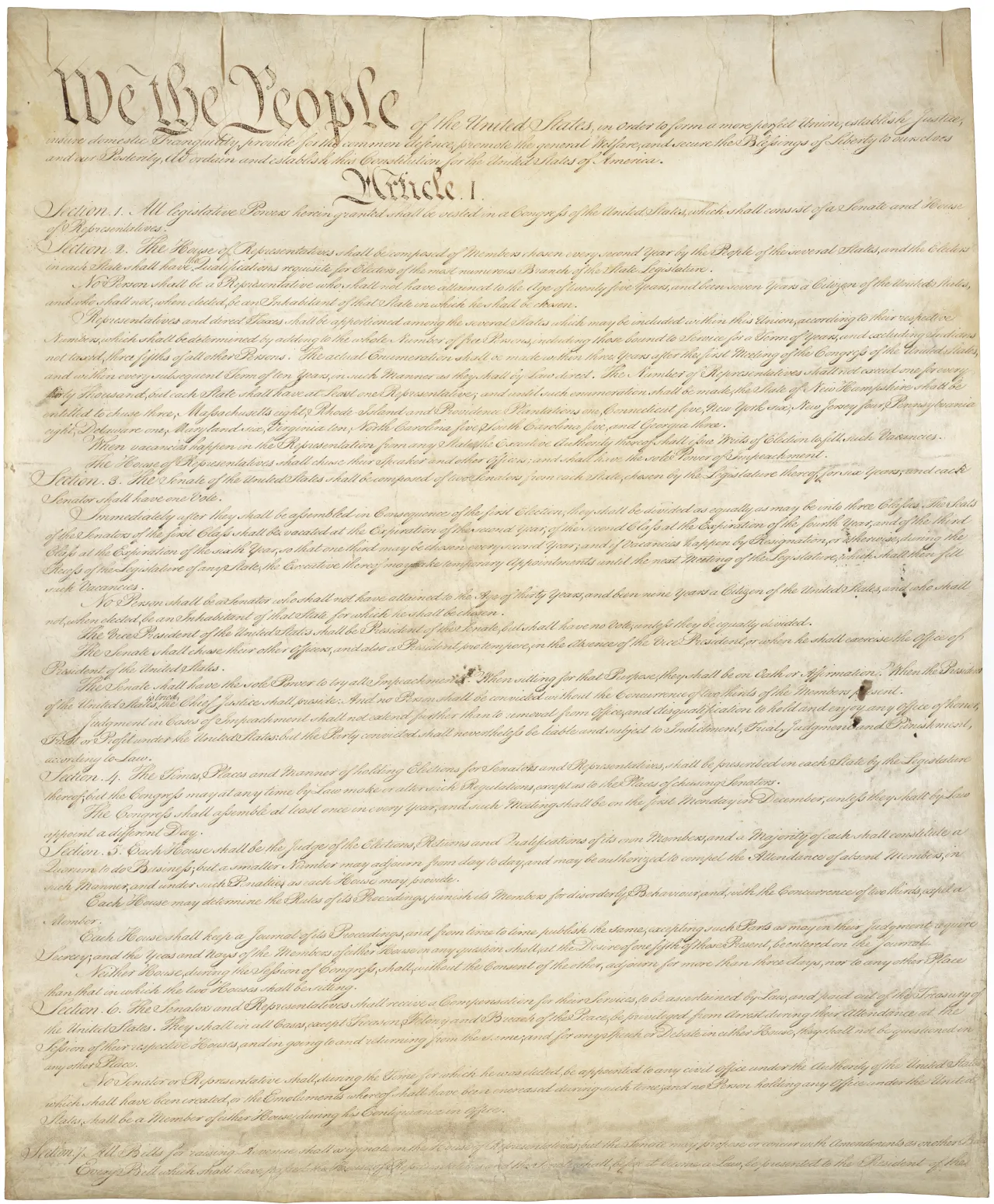
The U.S. Constitution starts with the words “We the People.” What does “We the People” mean?
- Self-government
- Popular sovereignty
- Consent of the governed
- People should govern themselves
- A social contract
“We the People” places the source of governmental authority in the people. The listed answers express this idea in several ways, including popular sovereignty and consent of the governed.
The Constitution begins with the people rather than a monarch’s name. The phrase expresses a source of authority, even though the country’s original political system excluded many people from equal participation.
USCIS 005Give one
How are changes made to the U.S. Constitution?
- Amendments
- The amendment process
An amendment changes or adds to the Constitution. Article V provides a more demanding process than passing an ordinary law, involving both proposal and ratification.
Article V separates proposing an amendment from ratifying it. This requires agreement across national and state institutions, making constitutional change harder than passing ordinary legislation.
USCIS 006Give one
What does the Bill of Rights protect?
- The basic rights of Americans
- The basic rights of people living in the United States
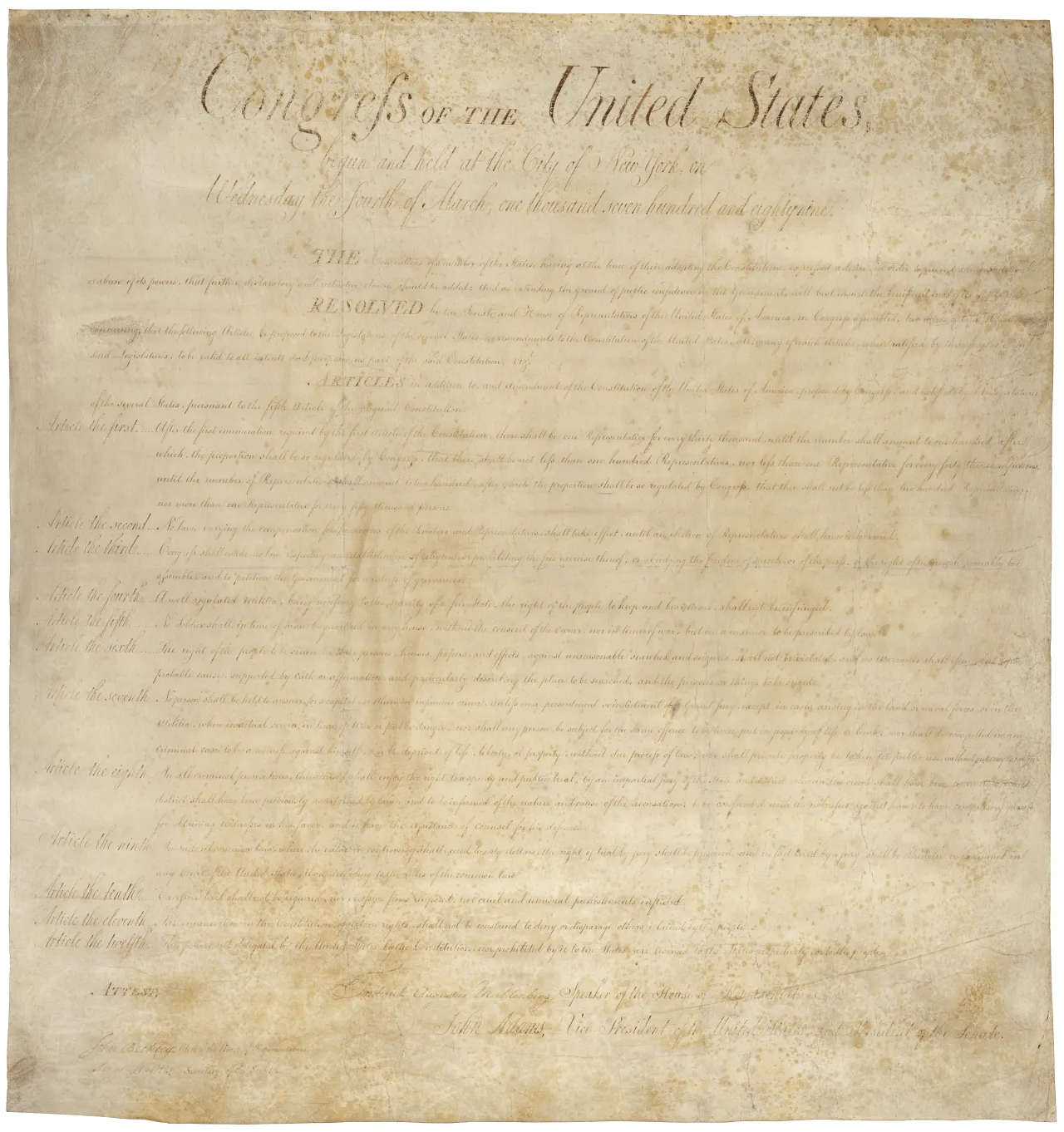
The Bill of Rights is the first ten amendments. These amendments protect basic freedoms and place limits on government; they are more than a list of benefits for citizens alone.
The First Amendment names expression, religion, assembly, and petition. Other amendments in the Bill of Rights protect people in criminal proceedings and limit government intrusion; the protections cover much more than voting.
USCIS 00765/20 · Give one
How many amendments does the U.S. Constitution have?
There are 27 amendments. The first ten make up the Bill of Rights; later amendments address subjects including slavery, voting rights, and presidential terms.
The first ten amendments were ratified together as the Bill of Rights in 1791. The 27th Amendment concerns the timing of congressional pay changes, illustrating that amendments can address government procedure as well as individual rights.
USCIS 008Give one
Why is the Declaration of Independence important?
- It says America is free from British control
- It says all people are created equal
- It identifies inherent rights
- It identifies individual freedoms
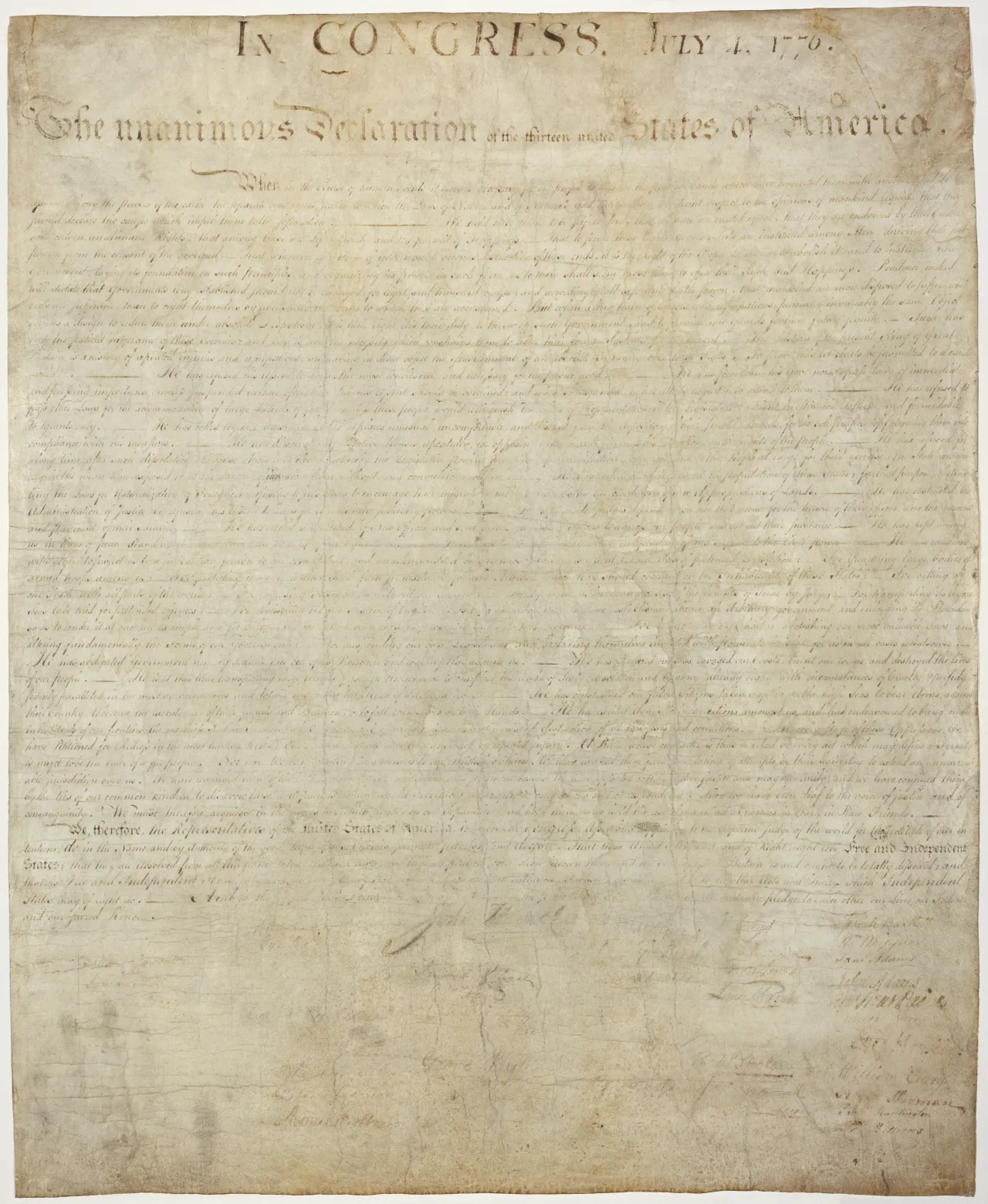
The Declaration announced independence from British rule and articulated ideas about equality and inherent rights. It serves a different purpose from the Constitution, which establishes the system of government.
The Declaration makes an argument about legitimate government: people have rights, governments are established to protect them, and authority depends on consent. Its equality language became a powerful resource for later movements challenging exclusion.
USCIS 009Give one
What founding document said the American colonies were free from Britain?
- Declaration of Independence
The Declaration of Independence announced the colonies’ separation from Britain. Keep that document distinct from the Constitution and from the Articles of Confederation.
The Declaration announced a political break. The Constitution came later and answered a different problem: how the independent states would govern together under a new national framework.
USCIS 010Give 2
Name two important ideas from the Declaration of Independence and the U.S. Constitution.
- Equality
- Liberty
- Social contract
- Natural rights
- Limited government
- Self-government
Equality, liberty, natural rights, limited government, and self-government are connected founding ideas. Equality concerns treatment; liberty concerns freedom; self-government concerns the source of political authority.
Liberty concerns freedom; equality concerns how people are treated. Limited government and self-government describe how authority should be exercised. These ideas overlap, but they are not interchangeable labels for the same concept.
USCIS 011Give one
The words “Life, Liberty, and the pursuit of Happiness” are in what founding document?
- Declaration of Independence
The phrase comes from the Declaration of Independence. It identifies rights that the Declaration says governments are created to secure, rather than describing a branch or office.
The passage identifies rights and then explains the purpose of government. It is part of the Declaration’s argument for independence, not a clause establishing a particular branch or office.
USCIS 01265/20 · Give one
What is the economic system of the United States?
- Capitalism
- Free market economy
Capitalism and a free market economy describe the central role of private enterprise and market exchange. They are alternative descriptions of the economic system, not two different required systems.
Private ownership and market exchange are central to capitalism. Recognizing that description does not mean government has no economic role: laws, public services, and regulation exist within the American economy.
USCIS 013Give one
What is the rule of law?
- Everyone must follow the law
- Leaders must obey the law
- Government must obey the law
- No one is above the law
The rule of law means that legal obligations apply to leaders and government as well as other people. A position of power does not put someone above the law.
The principle protects people against arbitrary power. A public official’s authority comes with legal limits; an election does not erase the obligations of the office.
USCIS 014Give one
Many documents influenced the U.S. Constitution. Name one.
- Declaration of Independence
- Articles of Confederation
- Federalist Papers
- Anti-Federalist Papers
- Virginia Declaration of Rights
- Fundamental Orders of Connecticut
- Mayflower Compact
- Iroquois Great Law of Peace
The constitutional debate drew on earlier experiments in government and arguments over national power. The Articles of Confederation, earlier declarations of rights, and writings about ratification all belong to that conversation.
The delegates drew on earlier experiments in self-government and a debate about how much national power was desirable. Writings opposing the proposed Constitution mattered as well as writings supporting it.
USCIS 015Give one
There are three branches of government. Why?
- So one part does not become too powerful
- Checks and balances
- Separation of powers
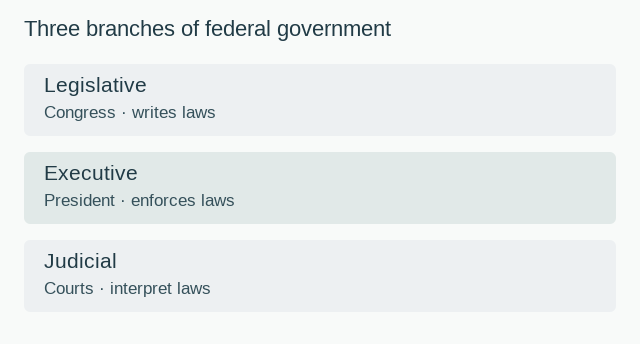
Dividing authority among three branches helps prevent any one part from concentrating too much power. Separation of powers describes the division; checks and balances describes how branches constrain each other.
The branches have separate responsibilities, but their work intersects. Congress passes bills, the president can sign or veto them, and courts can hear constitutional challenges to laws.
USCIS 016Give 3
Name the three branches of government.
- Legislative, executive, and judicial
- Congress, president, and the courts
The legislative branch makes laws, the executive carries them out, and the judicial branch interprets them. Congress, the president, and the courts are the corresponding institutions.
Think of responsibilities rather than buildings: lawmaking, carrying out the law, and deciding legal disputes. Congress has two chambers, but those chambers together form one legislative branch.
USCIS 017Give one
The President of the United States is in charge of which branch of government?
The president leads the executive branch. Congress belongs to the legislative branch, and the federal courts belong to the judicial branch.
Article II establishes the executive office. The Cabinet and federal executive departments help administer laws and policies; they do not form additional constitutional branches.
USCIS 018Give one
What part of the federal government writes laws?
- The U.S. Congress
- The national legislature
- Legislative branch
Congress is the federal lawmaking body. “Legislative branch” and “national legislature” are accepted descriptions of the same part of government.
Both chambers participate in the legislative process. A proposal generally must pass the House and Senate in the same form before it is presented to the president.
USCIS 019Give 2
What are the two parts of the U.S. Congress?
- The Senate and the House of Representatives
Congress has two chambers: the Senate and the House of Representatives. A complete answer names both, rather than choosing just one.
The two chambers represent people in different ways. The House distributes seats by population; the Senate gives every state equal representation.
USCIS 02065/20 · Give one
Name one power of the U.S. Congress.
- Writes laws
- Declares war
- Makes the federal budget
Congress writes laws, declares war, and makes the federal budget. These are national legislative powers, distinct from the president’s executive responsibilities.
Article I lists congressional powers. Declaring war and making the federal budget are legislative responsibilities, even though the executive branch conducts military operations and administers spending authorized by law.
USCIS 021Give one
How many U.S. senators are there?
Each of the 50 states has two senators, for a total of 100. This equal state representation differs from the population-based allocation of House seats.
The arithmetic is a useful memory aid: fifty states multiplied by two senators equals one hundred. House seats follow a different rule, based on population.
USCIS 022Give one
How long is a term for a U.S. senator?
A senator’s term lasts six years. Senate elections are staggered, so the whole Senate does not face election at the same time.
Senators belong to three election classes. Roughly one-third of the Senate’s seats come up for election every two years, combining a six-year term with regular opportunities for voters to change the chamber.
USCIS 023Give one
Who is one of your state’s U.S. senators now?
Your answer depends on where you live and who is serving when you are interviewed. Use the official Senate directory; the USCIS answer includes a specific exception for D.C. and U.S. territories.
Each state normally has two senators, so either serving senator can answer this question. A candidate elected to a future term is not the correct current officeholder until that person actually takes office.
USCIS 024Give one
How many voting members are in the House of Representatives?
USCIS expects 435, the authorized voting-seat count. Vacancies can make the number of currently serving members lower. The word “voting” matters because territories and the District of Columbia have a different form of representation.
The authorized number is not the same as a head count on a particular day. A resignation, death, or delayed swearing-in can leave a seat vacant without changing the number used in the USCIS study answer.
USCIS 025Give one
How long is a term for a member of the House of Representatives?
A representative’s term lasts two years. The shorter term creates more frequent opportunities for voters to choose their representatives.
All House seats are regularly contested every two years. This frequent election cycle is one reason the House was designed to respond more directly to public opinion.
USCIS 026Give one
Why do U.S. representatives serve shorter terms than U.S. senators?
- To more closely follow public opinion
House members serve shorter terms so they can respond more closely to public opinion. More frequent elections give voters more frequent opportunities to change their representatives.
The framers balanced responsiveness and continuity through different terms of office. The House’s short terms create frequent accountability; the Senate’s longer, staggered terms provide a different rhythm.
USCIS 027Give one
How many senators does each state have?
Every state has two senators, regardless of its population. That is why large and small states have equal numbers of Senate seats.
The smallest and largest states receive the same Senate delegation. Population affects the House, not the number of senators assigned to a state.
USCIS 028Give one
Why does each state have two senators?
- Equal representation for the states
- The Great Compromise, also called the Connecticut Compromise
Equal representation for states was part of the Great Compromise. Congress balances equal representation in the Senate with population-based representation in the House.
The Great Compromise helped resolve a conflict between large and small states at the Constitutional Convention. Equal state representation belongs to the Senate side of that arrangement.
USCIS 029Give one
Name your U.S. representative.
- Answers will vary. Residents of territories with nonvoting Delegates or Resident Commissioners may provide the name of that Delegate or Commissioner. Also acceptable is any statement that the territory has no voting representatives in Congress
Your U.S. representative depends on your congressional district, not just your state. Use the official House lookup and read the USCIS exceptions for territories and nonvoting representation.
A ZIP code can cross a district boundary, so it is not always enough to identify a representative. Use the official district lookup if you are uncertain; a recent election or boundary change also deserves a fresh check.
USCIS 03065/20 · Give one
What is the name of the Speaker of the House of Representatives now?
- Visit uscis.gov/citizenship/testupdates for the name of the Speaker of the House of Representatives
The Speaker leads the House of Representatives. The name can change, so the correct answer is the official serving at the time of the interview, not a former Speaker or a future candidate.
The Speaker is chosen by the House, not elected nationwide to that office. The Speaker is distinct from the Senate’s leaders, the president, and the Chief Justice.
USCIS 031Give one
Who does a U.S. senator represent?
- Citizens of their state
- People of their state
A senator represents the people of an entire state. A House member represents a smaller congressional district.
A senator represents a whole state, including people who did not vote for that senator. Representation is broader than membership in a political party or participation in the election.
USCIS 032Give one
Who elects U.S. senators?
- Citizens from their state
Citizens in a state elect that state’s U.S. senators. This question is about who votes, rather than the broader group of people the senator represents.
The 17th Amendment established direct election of senators. State legislatures originally selected them, which makes that older arrangement an understandable—but currently incorrect—answer.
USCIS 033Give one
Who does a member of the House of Representatives represent?
- Citizens in their congressional district
- Citizens in their district
- People in their congressional district
- People in their district
A representative serves the people in a congressional district. District boundaries determine the area represented; a House member does not represent an entire state in the same way as a senator.
A congressional district is the geographic area represented by one House member. The member’s responsibility is to the district’s people, not only to supporters or members of the same party.
USCIS 034Give one
Who elects members of the House of Representatives?
- Citizens in their congressional district
Citizens in a congressional district elect its House member. Distinguish the district’s voters from voters in other districts of the same state.
The district is the relevant electorate for a House race. A governor, senator, or national party leader does not choose all the state’s representatives in place of its voters.
USCIS 035Give one
Some states have more representatives than other states. Why?
- Differences in state population
- Their larger populations
- Differences in the number of people in each state
House representation is based on population. States with more people generally receive more seats, while every state still has two senators.
After each census, congressional apportionment distributes House seats among the states. Drawing district boundaries within a state is a related but different process.
USCIS 03665/20 · Give one
The President of the United States is elected for how many years?
A presidential term lasts four years. Keep the length of one term separate from the constitutional limits on how many times a person may be elected president.
The four-year term belongs to the office. The separate two-term restriction concerns how long a person may continue to hold the presidency through election, with additional constitutional details.
USCIS 037Give one
The President of the United States can serve only two terms. Why?
- The 22nd Amendment
- To keep the president from becoming too powerful
The 22nd Amendment limits presidential election to two terms, with additional rules for someone who serves part of another president’s term. The limit is intended to prevent a president from concentrating power indefinitely.
The 22nd Amendment was ratified after Franklin Roosevelt had been elected president four times. Its text includes a special rule for someone who serves more than two years of another president’s term.
USCIS 03865/20 · Give one
What is the name of the President of the United States now?
- Visit uscis.gov/citizenship/testupdates for the name of the President of the United States
The answer is the president serving at the time of the interview. A president-elect has not yet taken that office, and a former president is not the current officeholder.
The question asks who holds office now, not who won the most recent election or who will take office next. During a transition, those can be different people.
USCIS 03965/20 · Give one
What is the name of the Vice President of the United States now?
- Visit uscis.gov/citizenship/testupdates for the name of the Vice President of the United States
The answer is the vice president serving at the time of the interview. The vice president is distinct from the Speaker, the Chief Justice, and the president’s Cabinet secretaries.
The vice president has executive responsibilities and also serves as president of the Senate. That Senate role does not make the vice president a U.S. senator.
USCIS 040Give one
If the president can no longer serve, who becomes president?
- The vice president of the United States
The vice president succeeds the president if the president can no longer serve. This succession rule helps keep the executive branch functioning.
Succession is about continuity of the office. The 25th Amendment addresses presidential succession and inability, while the vice president is the first person in the succession order.
USCIS 041Give one
Name one power of the president.
- Signs bills into law
- Vetoes bills
- Enforces laws
- Commander in Chief of the military
- Chief diplomat
- Appoints federal judges
The president signs or vetoes bills, enforces laws, commands the military, conducts diplomacy, and appoints federal judges through the constitutional process. These powers do not eliminate the responsibilities of Congress or the courts.
Several presidential powers involve other institutions. Federal judicial nominations involve the Senate, and a veto can be overridden by Congress under constitutional rules.
USCIS 042Give one
Who is Commander in Chief of the U.S. military?
- The president of the United States
The president is Commander in Chief. Civilian leadership of the military is part of the constitutional structure.
Commander in Chief is a constitutional role of the elected civilian president. Military officers and the Secretary of Defense have important responsibilities without replacing that role.
USCIS 043Give one
Who signs bills to become laws?
- The president of the United States
The president signs bills passed by Congress to make them laws. The legislative and executive branches have different roles in this process.
Presidential signature is one route by which a bill becomes law. The Constitution also contains rules for vetoes, congressional overrides, and bills that become law without a signature.
USCIS 04465/20 · Give one
Who vetoes bills?
- The president of the United States
A veto is the president’s rejection of a bill. Congress has a constitutional process for overriding a veto, so the president’s role is part of a system of checks.
A veto sends a bill back with objections. Congress can override a regular veto with a two-thirds vote in each chamber, a concrete example of checks and balances.
USCIS 045Give one
Who appoints federal judges?
- The president of the United States
The president appoints federal judges. Senate advice and consent is another part of the process, but this question asks who appoints them.
A nomination and Senate confirmation are different steps. The president chooses a nominee; the Senate’s advice-and-consent role is part of the appointment process.
USCIS 046Give one
The executive branch has many parts. Name one.
- The president of the United States
- Cabinet
- Federal departments and agencies
The executive branch includes the president, the Cabinet, and federal departments and agencies. Congress and the federal courts belong to the other two branches.
An executive department administers a field of federal policy. A congressional committee may oversee a department, but that committee remains part of the legislative branch.
USCIS 047Give one
What does the President’s Cabinet do?
- Advises the president of the United States
The Cabinet advises the president. Cabinet members also lead major departments or serve in other designated positions.
Cabinet advice is not a substitute for the powers of Congress or the courts. Cabinet members help the president understand policy choices and manage executive responsibilities.
USCIS 048Give 2
What are two Cabinet-level positions?
- Attorney General
- Secretary of Agriculture
- Secretary of Commerce
- Secretary of Education
- Secretary of Energy
- Secretary of Health and Human Services
- Secretary of Homeland Security
- Secretary of Housing and Urban Development
- Secretary of the Interior
- Secretary of Labor
- Secretary of State
- Secretary of Transportation
- Secretary of the Treasury
- Secretary of Veterans Affairs
- Secretary of Defense
- Vice-President
- Administrator of the Environmental Protection Agency
- Administrator of the Small Business Administration
- Director of the Central Intelligence Agency
- Director of the Office of Management and Budget
- Director of National Intelligence
- United States Trade Representative
Cabinet-level roles include department secretaries and other designated officers, such as the vice president. The question asks for positions, so personal names are not needed.
This question asks for positions rather than personal names. Titles and Cabinet-level designations can change, so the full accepted source list matters more than assuming every important federal official is a Cabinet member.
USCIS 049Give one
Why is the Electoral College important?
- It decides who is elected president
- It provides a compromise between the popular election of the president and congressional selection
The Electoral College is part of the constitutional mechanism for choosing a president. It arose as a compromise between direct popular election and selection by Congress.
Voters choose presidential electors through state election processes. The constitutional system then uses electoral votes, rather than a single national popular-vote total, to determine the ordinary presidential election outcome.
USCIS 050Give one
What is one part of the judicial branch?
- Supreme Court
- Federal Courts
The Supreme Court and other federal courts are parts of the judicial branch. The Cabinet is executive; the Senate and House are legislative.
The federal judiciary includes trial courts, appeals courts, and the Supreme Court. A state court system is distinct from the federal judiciary even though both apply law.
USCIS 051Give one
What does the judicial branch do?
- Reviews laws
- Explains laws
- Resolves legal disputes
- Decides whether a law conflicts with the U.S. Constitution
Courts interpret laws and resolve legal disputes. They can also decide whether a law conflicts with the Constitution.
Interpreting a law is different from writing or administering it. Courts resolve actual legal disputes and can examine whether government action is consistent with the Constitution.
USCIS 05265/20 · Give one
What is the highest court in the United States?
The Supreme Court is the highest court in the United States. Other federal courts hear cases within the federal judicial system.
An appeal is not simply a new trial. The Supreme Court occupies the highest position in the federal judicial system and decides which many—but not all—requests for review it will hear.
USCIS 053Give one
How many seats are on the Supreme Court?
There are nine seats on the Supreme Court. A seat is a position on the Court; a temporary vacancy does not change the number of seats.
The Constitution creates the Supreme Court but does not fix the number of justices. Congress has set the size by statute, and nine is the authorized number used in the study bank.
USCIS 054Give one
How many Supreme Court justices are usually needed to decide a case?
Five justices form a majority of a full nine-member Supreme Court. The question says “usually” because vacancies and recusals can affect participation in particular cases.
Five is a majority of a full nine-member Court. Recusals or vacancies can affect a particular case, which is why this question says “usually” rather than stating that every case has exactly the same participation.
USCIS 055Give one
How long do Supreme Court justices serve?
- For life
- Lifetime appointment
- Until retirement
Supreme Court justices have lifetime appointments rather than fixed election terms. The official list also accepts service until retirement.
Article III uses the phrase “during good Behaviour.” A justice may retire or resign; the lifetime appointment is not a requirement to remain in office until death.
USCIS 056Give one
Supreme Court justices serve for life. Why?
- To remain independent of politics
- To limit outside political influence
Life tenure is intended to support judicial independence. It reduces the pressure to satisfy voters or political officials to remain in office.
Judges may decide cases that are unpopular with political leaders or the public. Life tenure is one protection intended to reduce pressure on those decisions.
USCIS 057Give one
Who is the Chief Justice of the United States now?
- Visit uscis.gov/citizenship/testupdates for the name of the Chief Justice of the United States
The Chief Justice leads the Supreme Court, but the officeholder’s name can change. Verify the official serving at your interview through the USCIS updates page; do not confuse the Chief Justice with the president or the Speaker.
The Chief Justice is one of the Court’s justices and also has particular administrative and constitutional duties. The title does not mean the Chief Justice can decide every case alone.
USCIS 058Give one
Name one power that is only for the federal government.
- Print paper money
- Mint coins
- Declare war
- Create an army
- Make treaties
- Set foreign policy
National powers include issuing U.S. currency, declaring war, making treaties, creating an army, and setting foreign policy. State licensing and local services belong to a different category in the study bank.
Currency, treaties, and national foreign policy concern the United States as a whole. State police, fire, and licensing services illustrate a different part of the constitutional division of responsibility.
USCIS 059Give one
Name one power that is only for the states.
- Provide schooling and education
- Provide police protection
- Provide fire protection
- Give a driver’s license
- Approve zoning and land use
State responsibilities include education, police and fire protection, driver licensing, and zoning. These familiar services help explain the division between national and state government.
A familiar service can help make federalism concrete: state and local institutions provide many everyday services. Real government often involves overlapping funding and regulation, so the test’s short categories should not be mistaken for a complete map of every responsibility.
USCIS 060Give one
What is the purpose of the 10th Amendment?
- Powers not given to the federal government belong to the states or the people
The 10th Amendment reserves powers not delegated to the United States or prohibited to the states to the states or the people. It is an important part of the constitutional division of authority.
Reserved powers are not a list of powers granted to a president. The amendment says that powers not delegated to the United States, nor prohibited to states, are reserved to the states or the people.
USCIS 06165/20 · Give one
Who is the governor of your state now?
- Answers will vary. District of Columbia residents should answer that D.C. does not have a governor
Your governor is a state-level official, and the name can change. D.C. residents should use the specific USCIS exception rather than naming a governor of a neighboring state.
A governor leads a state executive branch. The mayor of a city and the president of the United States hold different offices; D.C.’s specific exception should not be replaced with a neighboring state’s governor.
USCIS 062Give one
What is the capital of your state?
- Answers will vary. District of Columbia residents should answer that D.C. is not a state and does not have a capital. Residents of U.S. territories should name the capital of the territory
This answer depends on your state or territory. A state capital is not necessarily its largest city; D.C. residents have a specific exception in the official list.
The capital is the seat of a government, not necessarily the largest city. A state’s name, its largest city, and its capital can all be different.
USCIS 063Give one
There are four amendments to the U.S. Constitution about who can vote. Describe one of them.
- Citizens 18 and older can vote
- No poll tax is required to vote
- Voting rights cannot be denied on account of sex
- Voting rights cannot be denied on account of race
The voting amendments address race, sex, poll taxes in federal elections, and voting age. They place constitutional limits on particular reasons for denying a citizen the vote.
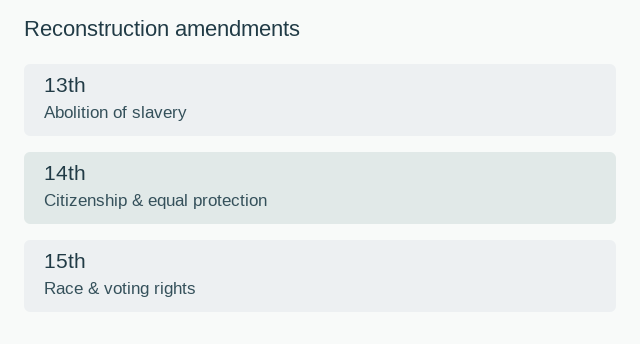
The 15th, 19th, 24th, and 26th Amendments address race, sex, poll taxes in federal elections, and voting age. Their adoption did not instantly remove every practical barrier to the ballot.
USCIS 064Give one
Who can vote in federal elections, run for federal office, and serve on a jury in the United States?
- Citizens
- Citizens of the United States
- U.S. citizens
U.S. citizenship is the category this question tests. Each activity also has its own qualifications, so citizenship alone does not establish eligibility for every federal office or every jury.
Citizenship is the category the question is testing. Each role also has its own rules and qualifications; for example, citizenship alone does not establish eligibility for every federal office.
USCIS 065Give 3
What are three rights of everyone living in the United States?
- Freedom of expression
- Freedom of assembly
- Freedom to petition the government
- Freedom of religion
- The right to bear arms
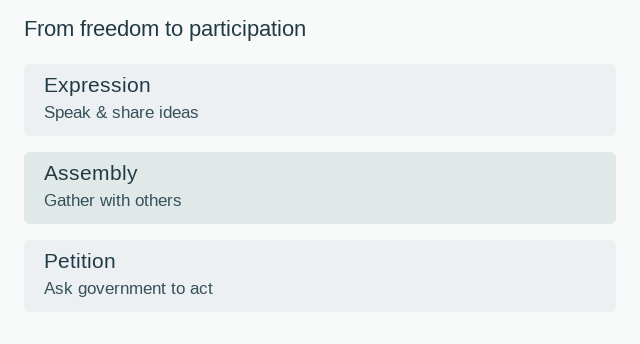
Expression, religion, assembly, petition, and the right to bear arms are among the protections named in the study bank. Speech and expression overlap; use distinct freedoms rather than two names for the same idea.
Speech and expression overlap, so repeating them does not demonstrate two different ideas. Assemble three distinct protections, such as religion, assembly, and petition, rather than collecting alternate names for one freedom.
USCIS 06665/20 · Give one
What do we show loyalty to when we say the Pledge of Allegiance?
- The United States
- The flag
The Pledge expresses loyalty to the United States and its flag. National allegiance is different from personal loyalty to an officeholder or a political party.
The flag is a symbol of the country. A pledge of national allegiance is different from personal loyalty to a president, an officeholder, or a political party.
USCIS 067Give 2
Name two promises that new citizens make in the Oath of Allegiance.
- Give up loyalty to other countries
- Defend the U.S. Constitution
- Obey the laws of the United States
- Serve in the military if needed
- Serve the nation if needed
- Be loyal to the United States
The Oath includes commitments to the Constitution, the laws, and the United States. Some promises concern military or national service if needed; those conditions are part of the commitment.
The Oath is a commitment to a constitutional country and its laws, not to one temporary administration. Some service promises include conditions; those conditions are part of the meaning.
USCIS 068Give one
How can people become United States citizens?
- Be born in the United States, under the conditions set by the 14th Amendment
- Naturalize
- Derive citizenship under conditions set by Congress
Citizenship can come through birth under constitutional conditions, naturalization, or derivation under conditions set by Congress. Permanent residence, a visitor visa, and citizenship are different statuses.
Citizenship, permanent residence, and permission to visit are different legal statuses. Marriage, property ownership, taxes, or a driver’s license do not by themselves turn a person into a citizen.
USCIS 069Give 2
What are two examples of civic participation in the United States?
- Vote
- Run for office
- Join a political party
- Help with a campaign
- Join a civic group
- Join a community group
- Give an elected official your opinion on an issue
- Support or oppose an issue or policy
- Write to a newspaper
Civic participation includes voting, organizing, communicating with elected officials, campaigning, and community activity. Public life continues between elections and includes people working together on shared concerns.
Participation can be collective and ongoing: people form associations, discuss issues, communicate with officials, and organize. An election is one part of civic life rather than its only occasion.
USCIS 070Give one
What is one way Americans can serve their country?
- Vote
- Pay taxes
- Obey the law
- Serve in the military
- Run for office
- Work for local, state, or federal government
Americans can serve through public responsibilities and service: voting, paying taxes, obeying the law, military service, elected office, or government work. Service is broader than holding a prominent office.
Public service happens at local, state, and national levels. A person can contribute through ordinary civic responsibilities as well as through elected or military office.
USCIS 071Give one
Why is it important to pay federal taxes?
- Required by law
- All people pay to fund the federal government
- Required under the U.S. Constitution’s 16th Amendment
- Civic duty
Federal taxes help fund the national government. Paying legally required taxes is a legal obligation and a civic duty; the 16th Amendment concerns federal income taxation.
Federal revenue supports public institutions and services. The 16th Amendment concerns income taxes; the broader congressional taxing power is also part of the constitutional system.
USCIS 072Give one
It is important for all men age 18 through 25 to register for the Selective Service. Name one reason why.
- Required by law
- Civic duty
- Makes the draft fair, if needed
Selective Service registration is required by law for covered people and is described as a civic duty. Registration can help make a draft fair if one is needed; registering is not the same as entering active military service.
Registration and active military service are not the same act. Selective Service registration preserves information for a possible draft; this question asks why registration is considered a civic responsibility.
USCIS 073Give one
The colonists came to America for many reasons. Name one.
- Freedom
- Political liberty
- Religious freedom
- Economic opportunity
- Escape persecution
People came to the colonies for different reasons, including freedom, economic opportunity, and escape from persecution. No single motive describes every person’s experience.
Colonial migration was not one shared experience. Some people sought religious or political freedom, while others sought work or land; forced migration and dispossession are also essential parts of the colonial story.
USCIS 07465/20 · Give one
Who lived in America before the Europeans arrived?
- American Indians
- Native Americans
Native peoples lived in America before European arrival. American Indians and Native Americans are broad accepted descriptions, not the name of a single nation or culture.
The continent was home to many nations, languages, and forms of government. “Native Americans” is a broad accepted answer here, not the name of a single people or a suggestion that Native history ended with European arrival.
USCIS 075Give one
What group of people was taken and sold as slaves?
- Africans
- People from Africa
Africans were forcibly taken and sold into slavery. The wording distinguishes forced enslavement from voluntary migration.
The transatlantic slave trade forcibly transported Africans and treated people as property. Enslaved people and their descendants resisted slavery and played a central role in the struggle for freedom.
USCIS 076Give one
What war did the Americans fight to win independence from Britain?
- American Revolution
- The American Revolutionary War
- The American War of Independence
The American Revolution was the war for independence from Britain. Revolutionary War and War for American Independence are other names for the same struggle.
The war is also called the Revolutionary War or the War for American Independence. The Declaration was a political act within the struggle, not a separate war.
USCIS 077Give one
Name one reason why the Americans declared independence from Britain.
- High taxes
- Taxation without representation
- British soldiers were quartered in colonists’ homes
- They did not have self-government
- Boston Massacre
- The Boston Tea Party and the Tea Act
- Stamp Act
- Sugar Act
- Townshend Acts
- The Intolerable Acts
Colonists opposed taxation without representation and restrictions on self-government. British troops, trade and tax policies, and confrontations such as the Boston Massacre and Tea Party contributed to the conflict.
Taxation without representation links the tax dispute to the question of political authority. The conflict also involved soldiers, trade rules, and the colonists’ ability to govern their own affairs.
USCIS 07865/20 · Give one
Who wrote the Declaration of Independence?
Thomas Jefferson wrote the Declaration of Independence. The document was considered and adopted by the Continental Congress.
Jefferson was the principal drafter, working within a committee and a Congress that revised the document. Recognizing his role need not erase that collaborative political process.
USCIS 079Give one
When was the Declaration of Independence adopted?
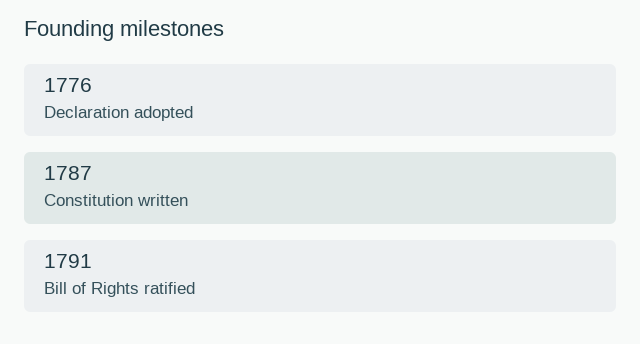
The Declaration was adopted on July 4, 1776. That date is commemorated by Independence Day. Keep the year 1776 separate from 1787, when the Constitution was written.
Congress voted for independence on July 2 and adopted the Declaration’s text on July 4, 1776. Those are related events, but this question asks about the adoption date.
USCIS 080Give one
The American Revolution had many important events. Name one.
- The Battle of Bunker Hill
- Declaration of Independence
- Washington’s crossing of the Delaware
- The Battle of Saratoga
- The encampment at Valley Forge
- The British surrender at Yorktown
The Revolution included political decisions, battles, military turning points, and periods of hardship. The Declaration, Valley Forge, and Yorktown are different kinds of event within the same struggle.
Not every accepted event is a battle. The Declaration and the winter encampment at Valley Forge are part of the Revolutionary story alongside military turning points.
USCIS 081Give 5
There were 13 original states. Name five.
- New Hampshire
- Massachusetts
- Rhode Island
- Connecticut
- New York
- New Jersey
- Pennsylvania
- Delaware
- Maryland
- Virginia
- North Carolina
- South Carolina
- Georgia
The thirteen original states grew from British colonies on the Atlantic seaboard. Later states, even nearby ones such as Vermont and Maine, are not separate members of that founding group.
The original thirteen were former British colonies that became states. Later statehood does not change the membership of that founding group; Maine and Vermont, for example, were not separate original states.
USCIS 082Give one
What founding document was written in 1787?
The Constitution was written in 1787. The Declaration of Independence was adopted earlier, in 1776. The two documents play different roles: announcing independence and establishing the framework of government.
The delegates met in Philadelphia and produced a new constitutional framework. Ratification by the states was a separate stage after the document was written.
USCIS 083Give one
The Federalist Papers supported the passage of the U.S. Constitution. Name one of the writers.
- James Madison
- Alexander Hamilton
- John Jay
- Publius
James Madison, Alexander Hamilton, and John Jay wrote the Federalist Papers under the shared pen name Publius. The essays explained and argued for the proposed Constitution.
Publius was a shared pen name, not a fourth individual author. Hamilton, Madison, and Jay used essays to address objections and explain the proposed national framework.
USCIS 084Give one
Why were the Federalist Papers important?
- They helped people understand the U.S. Constitution
- They supported ratification of the U.S. Constitution
The Federalist Papers explained and advocated the proposed Constitution. They were part of the public debate about ratification.
The essays were arguments in a ratification debate. Reading them alongside opponents of the Constitution shows that the final framework was contested rather than universally accepted from the start.
USCIS 085Give one
Benjamin Franklin is famous for many things. Name one.
- Founded the first free public libraries
- First Postmaster General of the United States
- Helped write the Declaration of Independence
- Inventor
- U.S. diplomat
Benjamin Franklin helped build public institutions, worked as a diplomat, contributed to the Declaration, and pursued science and invention. He never served as a U.S. president.
Franklin’s public work crossed the Atlantic and several professions. Libraries, postal service, diplomacy, science, and printing provide more useful connections than treating him simply as another early president—an office he never held.
USCIS 08665/20 · Give one
George Washington is famous for many things. Name one.
- “Father of Our Country”
- First president of the United States
- General of the Continental Army
- President of the Constitutional Convention
George Washington commanded the Continental Army, presided over the Constitutional Convention, and became the first president. His role in establishing the country explains the title Father of Our Country.
Washington’s military and civilian roles connect the Revolution to the new republic. After leading the Continental Army, he presided over the Constitutional Convention and became the first president.
USCIS 087Give one
Thomas Jefferson is famous for many things. Name one.
- Writer of the Declaration of Independence
- Third president of the United States
- Doubled the country’s size through the Louisiana Purchase
- First Secretary of State
- Founded the University of Virginia
- Writer of the Virginia Statute on Religious Freedom
Thomas Jefferson wrote the Declaration, served as the third president and first Secretary of State, and is associated with the Louisiana Purchase and the University of Virginia. These roles connect founding ideas with later government.
Jefferson’s career links the Declaration to diplomacy, the presidency, territorial expansion, and education. Those contributions also sit within a history that includes his participation in slavery and the exclusion of many people from the freedoms he articulated.
USCIS 088Give one
James Madison is famous for many things. Name one.
- “Father of the Constitution”
- Fourth president of the United States
- President during the War of 1812
- One of the writers of the Federalist Papers
James Madison helped frame and defend the Constitution, wrote Federalist essays, and became the fourth president. He led the country during the War of 1812.
Madison helped develop and defend the constitutional framework, then served as president during the War of 1812. The “Father of the Constitution” title is shorthand for influence, not a claim that he wrote it alone.
USCIS 089Give one
Alexander Hamilton is famous for many things. Name one.
- First Secretary of the Treasury
- One of the writers of the Federalist Papers
- Helped establish the First Bank of the United States
- Aide to General George Washington
- Member of the Continental Congress
Alexander Hamilton served as the first Secretary of the Treasury and helped build national financial institutions. His work also included the Federalist Papers and service alongside Washington.
Hamilton’s Treasury work concerned national credit and financial institutions. His Federalist essays connect the debate over the Constitution to the practical task of building the new government.
USCIS 090Give one
What territory did the United States buy from France in 1803?
- Louisiana Territory
- Louisiana
The Louisiana Purchase acquired a large territory from France in 1803. It was much larger than the present-day state of Louisiana.
The purchased territory extended far beyond today’s Louisiana. The transaction greatly expanded the claimed territory of the United States while also affecting Native nations already living there.
USCIS 091Give one
Name one war fought by the United States in the 1800s.
- War of 1812
- Mexican-American War
- Civil War
- Spanish-American War
The War of 1812, the Mexican-American War, the Civil War, and the Spanish-American War took place in the nineteenth century. The World Wars belong to the following century.
Use the century as an organizing tool: the War of 1812, the Civil War, and the Spanish-American War all belong to the 1800s. The name of a war sometimes supplies the date; otherwise a timeline helps.
USCIS 092Give one
Name the U.S. war between the North and the South.
The Civil War was fought between the Union and the Confederacy. In the wording of the test, it is the war between the North and the South.
The Union fought the Confederacy after Southern states seceded. Slavery was central to the causes of secession and the conflict, even though the aims and course of the war developed over time.
USCIS 093Give one
The Civil War had many important events. Name one.
- The Battle of Fort Sumter
- Emancipation Proclamation
- The Battle of Vicksburg
- The Battle of Gettysburg
- Sherman’s March
- The surrender at Appomattox
- The Battle of Antietam
- Lincoln was assassinated
The Civil War included battles such as Gettysburg, the Emancipation Proclamation, surrender at Appomattox, and Lincoln’s assassination. These events mark different military and political turning points.
Battles, emancipation, surrender, and assassination mark different kinds of turning point. Connect an event with its consequence rather than memorizing a disconnected list of place names.
USCIS 09465/20 · Give one
Abraham Lincoln is famous for many things. Name one.
- Issued the Emancipation Proclamation
- Preserved the Union
- Led the United States during the Civil War
- 16th president of the United States
- Delivered the Gettysburg Address
Abraham Lincoln led the United States during the Civil War, worked to preserve the Union, issued the Emancipation Proclamation, and delivered the Gettysburg Address. He was the 16th president.
Lincoln’s presidency connects preservation of the Union with emancipation. The Gettysburg Address interpreted the war as a test of a nation founded on equality and government by the people.
USCIS 095Give one
What did the Emancipation Proclamation do?
- Freed the slaves
- Freed slaves in the Confederacy
- Freed slaves in the Confederate states
- Freed slaves in most Southern states
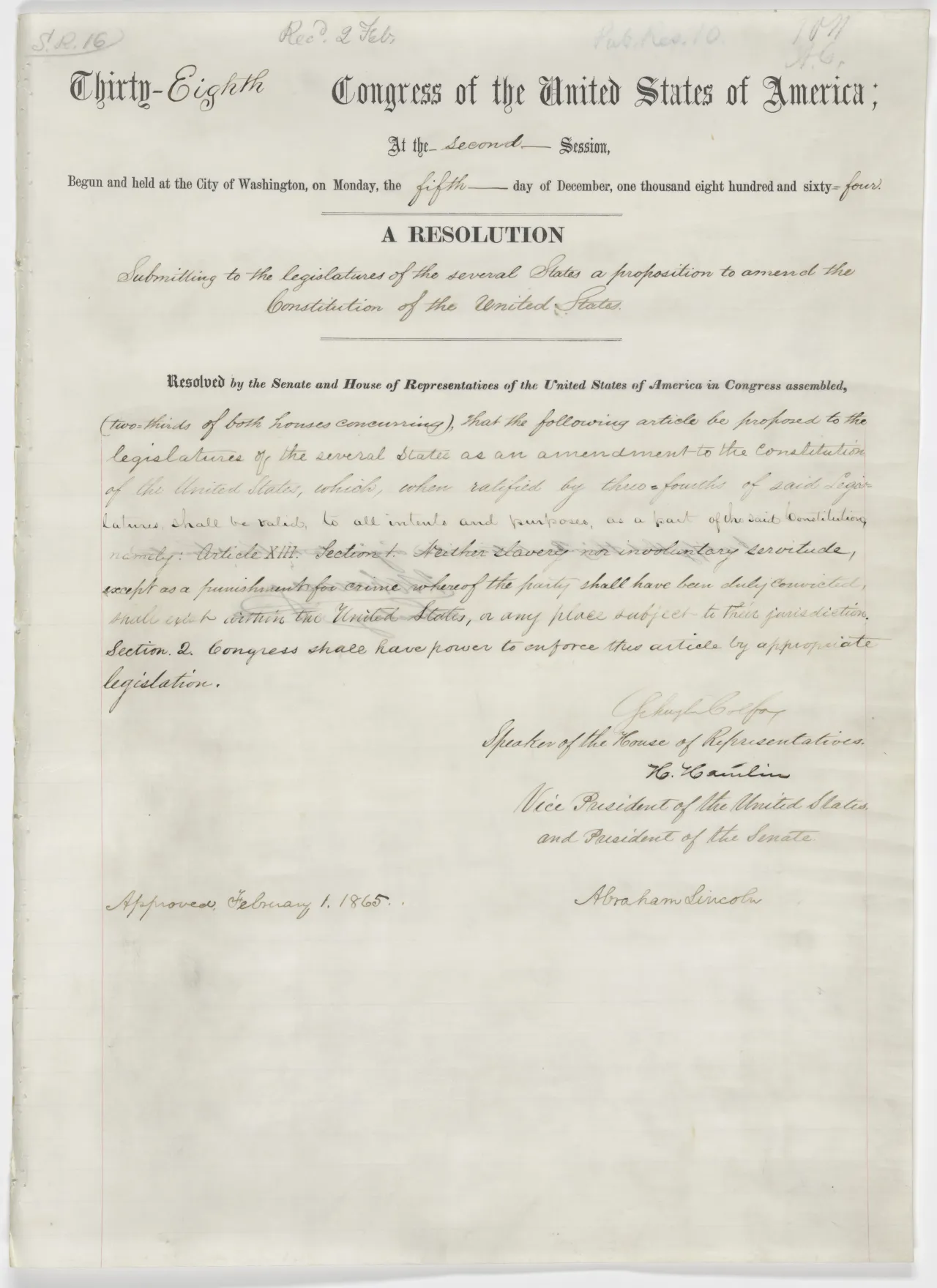
The Emancipation Proclamation applied to enslaved people in areas in rebellion, not immediately to every enslaved person nationwide. The 13th Amendment later abolished slavery constitutionally, with its stated exception.
The proclamation was a wartime measure directed at areas in rebellion. It strengthened the Union’s commitment to emancipation and authorized Black military service, while constitutional abolition came through the 13th Amendment.
USCIS 096Give one
What U.S. war ended slavery?
The Civil War is the accepted study answer. The end of slavery also involved emancipation during the conflict and constitutional abolition through the 13th Amendment.
The end of slavery involved enslaved people’s actions, wartime policy, Union victory, and constitutional change. The war and the 13th Amendment belong to the same story but are not the same document or event.
USCIS 097Give one
What amendment says all persons born or naturalized in the United States, and subject to the jurisdiction thereof, are U.S. citizens?
This citizenship language comes from the 14th Amendment. Preserve the phrase “subject to the jurisdiction thereof” when studying the constitutional text.
The citizenship clause is followed by protections concerning due process and equal protection. Its text distinguishes constitutional citizenship from holding a state-issued document or simply owning property.
USCIS 098Give one
When did all men get the right to vote?
- After the Civil War
- During Reconstruction
- The 15th Amendment
- 1870
The study answer points to Reconstruction and the 15th Amendment in 1870. The amendment prohibited race-based denial of voting rights, but discrimination and disenfranchisement continued afterward.
The 15th Amendment prohibited denial of voting rights because of race, color, or previous condition of servitude. Violence, discriminatory administration, and other barriers continued to prevent many Black men from voting.
USCIS 099Give one
Name one leader of the women’s rights movement in the 1800s.
- Susan B. Anthony
- Elizabeth Cady Stanton
- Sojourner Truth
- Harriet Tubman
- Lucretia Mott
- Lucy Stone
The women’s rights movement had many leaders, including Susan B. Anthony, Elizabeth Cady Stanton, Sojourner Truth, Harriet Tubman, Lucretia Mott, and Lucy Stone. Their work was part of a long struggle rather than one isolated campaign.
The movement used conventions, petitions, speeches, newspapers, and organizing. Its history includes disagreement over strategy and race as well as cooperation among leaders.
USCIS 100Give one
Name one war fought by the United States in the 1900s.
- World War I
- World War II
- Korean War
- Vietnam War
- The Persian Gulf War
The United States fought in both World Wars, Korea, Vietnam, and the Persian Gulf War during the twentieth century. A timeline helps keep these conflicts distinct from earlier American wars.
The twentieth-century questions move through two World Wars and later conflicts in Korea, Vietnam, and the Persian Gulf. Learning their order prevents wars with similar broad explanations from blending together.
USCIS 101Give one
Why did the United States enter World War I?
- Germany attacked U.S. civilian ships
- To support the Allied Powers
- To oppose the Central Powers
German attacks on U.S. civilian ships helped bring the country into World War I. Supporting the Allied Powers and opposing the Central Powers describe the same conflict from different sides.
The United States entered World War I in 1917, years after the war began in Europe. Attacks on shipping and the alignment of opposing alliances are central to the accepted study explanations.
USCIS 102Give one
When did all women get the right to vote?
- 1920
- After World War I
- The 19th Amendment
The 19th Amendment was ratified in 1920 and barred denying voting rights on account of sex. The test’s simplified wording does not mean all women could actually exercise the vote without further barriers.
The 19th Amendment prohibited sex-based denial of the vote. Many women of color still faced barriers after 1920, so the study question’s phrase “all women” should not be read as a description of equal access in every community.
USCIS 103Give one
What was the Great Depression?
- Longest economic recession in modern history
The Great Depression was a long and severe economic downturn. It affected employment, banks, businesses, and household security.
A financial crash is an event; a depression is a prolonged economic crisis. Unemployment, bank failures, falling business activity, and insecure housing made the Depression part of daily life for millions of people.
USCIS 104Give one
When did the Great Depression start?
- The stock market crash of 1929
- Stock market crash of 1929
The stock-market crash of 1929 is the study bank’s starting landmark for the Great Depression. The economic crisis lasted much longer than the crash itself.
The stock-market crash of 1929 is the landmark used in this question. The Depression’s development was more complex than a single day, and its effects continued long after the crash.
USCIS 105Give one
Who was president during the Great Depression and World War II?
Franklin Roosevelt was president during much of the Great Depression and during World War II. Do not confuse him with Theodore Roosevelt, an earlier president.
Franklin Roosevelt took office in 1933 and was president when the United States entered World War II in 1941. Theodore Roosevelt, who served earlier, is a different president despite the shared surname.
USCIS 106Give one
Why did the United States enter World War II?
- The bombing of Pearl Harbor
- Japanese attacked Pearl Harbor
- To support the Allied Powers
- To oppose the Axis Powers
The Japanese attack on Pearl Harbor brought the United States into World War II. Supporting the Allies and opposing the Axis describe the broader alignment of the war.
Japan attacked Pearl Harbor on December 7, 1941. The attack brought the United States into a war already underway abroad; the wider conflict involved the Allied and Axis coalitions.
USCIS 107Give one
Dwight Eisenhower is famous for many things. Name one.
- General during World War II
- President at the end of the Korean War
- 34th president of the United States
- Signed the 1956 law creating the Interstate Highway System
Dwight Eisenhower was a World War II general before becoming the 34th president. His presidency is associated with the end of the Korean War and the Interstate Highway System.
Eisenhower’s career provides a bridge between wartime command and postwar domestic policy. His role in the Interstate Highway System is different from inventing the automobile or writing the Constitution.
USCIS 108Give one
Who was the United States’ main rival during the Cold War?
The Soviet Union was the principal U.S. rival during the Cold War. USSR is its abbreviation; the study bank also accepts Russia, although the Soviet Union included more than Russia alone.
The Soviet Union was a multi-republic state, not simply a formal alternative name for the modern Russian Federation. The study bank accepts “Russia,” but the fuller historical label is useful for understanding the period.
USCIS 109Give one
During the Cold War, what was one main concern of the United States?
Communism and nuclear war were major U.S. concerns during the Cold War. Political rivalry and the danger of nuclear conflict shaped diplomacy, alliances, and domestic debate.
The Cold War involved ideological rivalry, nuclear danger, diplomacy, military alliances, and conflicts beyond the United States and Soviet Union. “Cold” does not mean that the period was free of warfare.
USCIS 110Give one
Why did the United States enter the Korean War?
- To stop the spread of communism
Stopping the spread of communism is the accepted study explanation for U.S. entry into the Korean War. The conflict is part of Cold War history, not the Revolutionary or World War I periods.
The Korean War began in 1950. The accepted explanation places U.S. involvement within Cold War efforts to contain communism; the peninsula’s own history and the experiences of Koreans make the broader story more complex.
USCIS 111Give one
Why did the United States enter the Vietnam War?
- To stop the spread of communism
Stopping the spread of communism is the accepted study explanation for U.S. entry into the Vietnam War. That short answer is a starting point for a much more complex history.
The accepted study answer is a Cold War explanation, not a complete account of Vietnam’s history. The war involved decolonization, nationalism, rival governments, and intense debate within the United States.
USCIS 112Give one
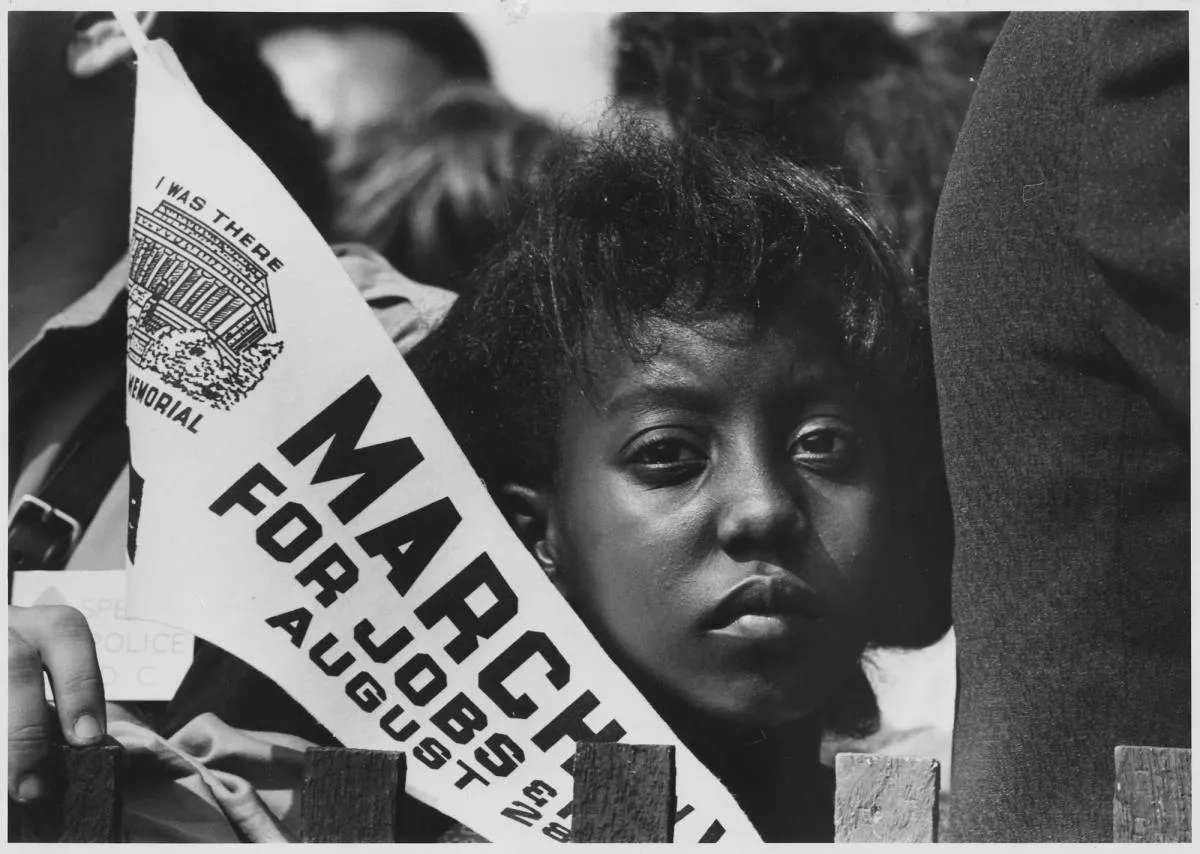
What did the civil rights movement do?
- Fought to end racial discrimination
The civil rights movement fought racial discrimination. It sought to make legal rights and equal treatment effective in daily life.
The movement challenged segregation and unequal treatment through organizing, legal action, protest, and legislation. It was built by many local communities and organizations as well as nationally known leaders.
USCIS 11365/20 · Give one
Martin Luther King, Jr. is famous for many things. Name one.
- Fought for civil rights
- Worked for equality for all Americans
- Worked to ensure that people would “not be judged by the color of their skin, but by the content of their character”
Martin Luther King, Jr. worked for civil rights and equality. His leadership connected the country’s constitutional promises with nonviolent organizing for change.
King’s leadership is closely associated with nonviolent protest, voting rights, and equal citizenship. His public work connected constitutional promises with demands for change in schools, employment, and public life.
USCIS 114Give one
Why did the United States enter the Persian Gulf War?
- To force the Iraqi military from Kuwait
The United States entered the Persian Gulf War to force Iraqi troops out of Kuwait. This was the 1991 conflict, distinct from the later Iraq War.
Iraq invaded Kuwait in 1990. The U.S.-led coalition’s 1991 war aimed to remove Iraqi forces from Kuwait; it should be distinguished from the later Iraq War that began in 2003.
USCIS 11565/20 · Give one
What major event happened on September 11, 2001 in the United States?
- Terrorists attacked the United States
- Terrorists took over two planes and crashed them into the World Trade Center in New York City
- Terrorists took over a plane and crashed into the Pentagon in Arlington, Virginia
- Terrorists took over a plane originally aimed at Washington, D.C., and crashed in a field in Pennsylvania
The September 11 attacks targeted the United States with hijacked airplanes. The official list includes the World Trade Center, the Pentagon, and the crash in Pennsylvania.
Four hijacked aircraft were used in the attacks: two struck the World Trade Center, one struck the Pentagon, and one crashed in Pennsylvania. The Pennsylvania crash followed resistance by passengers and crew.
USCIS 116Give one
Name one U.S. military conflict after the September 11, 2001 attacks.
- The War on Terror
- War in Afghanistan
- War in Iraq
The War on Terror, the war in Afghanistan, and the war in Iraq are accepted examples after the September 11 attacks. These labels refer to related but distinct military conflicts.
The Afghanistan and Iraq wars followed September 11 but were distinct conflicts. The broad label “War on Terror” should not make their different histories and decisions disappear.
USCIS 117Give one
Name one American Indian tribe in the United States.
- Apache
- Blackfeet
- Cayuga
- Cherokee
- Cheyenne
- Chippewa
- Choctaw
- Creek
- Crow
- Hopi
- Huron
- Inupiat
- Lakota
- Mohawk
- Mohegan
- Navajo
- Oneida
- Onondaga
- Pueblo
- Seminole
- Seneca
- Shawnee
- Sioux
- Teton
- Tuscarora
For a complete list of tribes, please visit bia.gov.
American Indian tribes are distinct peoples and political communities. The study list is not exhaustive, so an unlisted valid tribal name needs verification rather than automatic rejection.
The official study list gives examples rather than a complete inventory. Native nations are contemporary communities and governments as well as historical peoples; an unfamiliar valid tribal name deserves verification, not automatic rejection.
USCIS 118Give one
Name one example of an American innovation.
- Light bulb
- The automobile
- Skyscrapers
- Airplane
- Assembly line
- Landing on the moon
- The integrated circuit
The study bank names examples such as the light bulb, airplane, assembly line, moon landing, and integrated circuit. Innovation often involves many contributors and improvements rather than one inventor acting alone.
Innovation can involve many contributors, improvements, and applications. The study list’s examples are not claims that every component was invented in the United States or that a single person created a technology alone.
USCIS 119Give one
What is the capital of the United States?
Washington, D.C. is the national capital. It is a federal district, distinct from Washington state. The national capital is also different from your state capital, which appears in a separate question.
Washington, D.C. is not Washington state. The federal district was established as the national seat of government rather than as a state capital, which explains the different answers in the local-government questions.
USCIS 120Give one
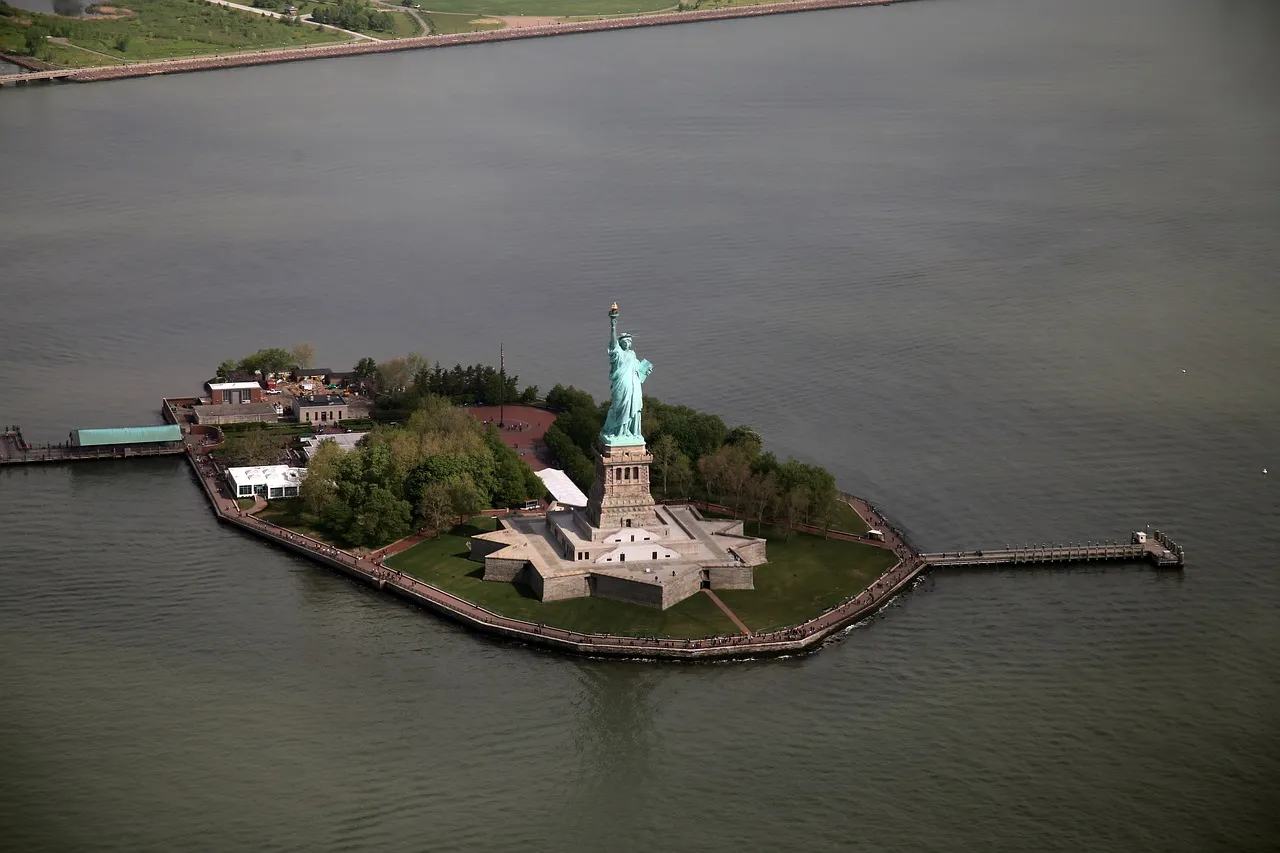
Where is the Statue of Liberty?
- New York Harbor
- Liberty Island
- New Jersey
- Near New York City
- On the Hudson River
The Statue of Liberty stands on Liberty Island in New York Harbor. USCIS expressly accepts broader location descriptions, including New Jersey, near New York City, and the Hudson River.
The statue stands on Liberty Island in New York Harbor. USCIS accepts several broader location descriptions; “New Jersey” and “near New York City” must not be rejected simply because a guide prints only one preferred phrase.
USCIS 12165/20 · Give one
Why does the flag have 13 stripes?
- The 13 original colonies
- The stripes represent the original colonies
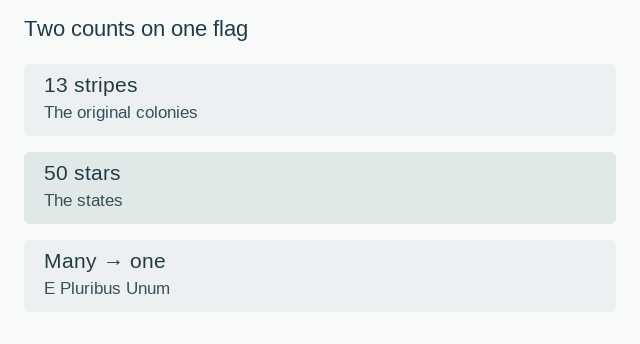
The thirteen stripes represent the original colonies. The stars represent the states, so the two parts of the flag refer to different counts.
The stripe count stayed at thirteen to recall the founding colonies. The number of stars changed as states entered the Union, so the two design elements follow different historical rules.
USCIS 122Give one
Why does the flag have 50 stars?
- One star for each state
- Each star represents a state
- The 50 states
The flag has one star for each of the fifty states. This differs from the fixed thirteen stripes representing the original colonies.
A star represents a state, not a senator, a president, or an amendment. Each state receives one star regardless of the state’s population or size.
USCIS 123Give one
What is the name of the national anthem?
The national anthem is “The Star-Spangled Banner.” Other well-known patriotic songs have different titles and are not the anthem.
Francis Scott Key’s 1814 poem was inspired by the flag at Fort McHenry during the War of 1812. Congress made the song the national anthem in 1931, long after it became a familiar patriotic song.
USCIS 124Give one
The Nation’s first motto was “E Pluribus Unum.” What does that mean?
- Out of many, one
- We all become one
E Pluribus Unum means Out of many, one. It expresses national unity from plurality; it does not mean In God We Trust, a different motto.
The motto describes unity drawn from plurality. It is different from “In God We Trust,” another national motto with a different meaning and history.
USCIS 125Give one
What is Independence Day?
- A holiday celebrating U.S. independence from Britain
- The country’s birthday
Independence Day celebrates U.S. independence from Britain. It is observed on July 4, the date associated with adoption of the Declaration.
The holiday marks independence from Britain through the Declaration’s July 4 adoption date. It does not commemorate the later writing or ratification of the Constitution.
USCIS 12665/20 · Give 3
Name three national U.S. holidays.
- New Year’s Day
- Martin Luther King, Jr. Day
- Presidents Day, also called Washington’s Birthday
- Memorial Day
- Juneteenth
- Independence Day
- Labor Day
- Columbus Day
- Veterans Day
- Thanksgiving Day
- Christmas Day
The accepted list includes holidays such as New Year’s Day, Juneteenth, Independence Day, Labor Day, and Thanksgiving. An important calendar observance is not necessarily a federal holiday.
The question concerns the national holiday list, not every observance found on a calendar. A day can be culturally important or officially commemorated without being one of the federal holidays accepted here.
USCIS 127Give one
What is Memorial Day?
- A holiday to honor soldiers who died in military service
Memorial Day honors those who died in military service. Distinguish it from Veterans Day, which honors those who have served.
Memorial Day’s focus is those who died in military service. Keeping that purpose distinct from Veterans Day helps explain why the country observes both.
USCIS 128Give one
What is Veterans Day?
- A holiday honoring people in the U.S. military
- A holiday honoring people who have served in the U.S. military
Veterans Day honors people who have served in the military. Memorial Day specifically remembers those who died in military service.
Veterans Day honors military service more broadly than a memorial to those who died. The name grew from the November 11 Armistice Day observance connected with the end of World War I fighting.